Questions? Call: 0763 484 869 Monday-Friday | 08:00 - 18:00


Free delivery up to 10% from the order value
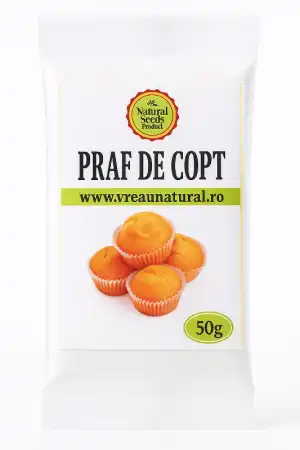
Baking powder 50g, Natural Seeds Product, wholesale Supreva
In stock | |
| Return period | The product is not returnable. |
| Delivery time (days) | 1-2 days |
| Country of dispatch |  Romania Romania |
| Destination countries |         |
Minimum quantity: 6
Choose multiple of 6
≈1.98 €
10.50 RON
Price with VAT ≈2.20 €
11.66 RON
115 other people chose this product.
Benefit from secure payments through Supreva payment methods.
Description
Baking powder is actually a dry chemical leavening agent which is a mixture of carbonate or bicarbonate and a weak acid and is used to increase the volume and clarify the texture of baked goods. Baking powder consists of sodium bicarbonate (sodium bicarbonate, NaHCO3), cream of tartar (potassium bitartrate, C4H5KO6) and corn starch. The difference between baking powder and bicarbonate Bicarbonate and baking powder are among the most used leavening agents for doughs nowadays. However, there are not a few who wonder what is the difference between the two or if they can replace each other. The main similarity between the two products is that they both contain sodium bicarbonate. However, we must know that bicarbonate can only be activated with the help of an acidic ingredient (lemon juice, cream, sweet cheese, etc.). In other words, in the absence of an ingredient that activates it, bicarbonate will not loosen the dough. Unlike bicarbonate, baking powder does not need another acid to make the dough rise, it already has it in its composition. Another difference between the two loosening agents is the shelf life: bicarbonate has a very long term, while baking powder can lose its properties much faster, especially if it is stored in a humid place. Baking powder can be successfully replaced by sodium bicarbonate, the measure being one teaspoon of baking soda for one packet of baking powder. It is usually good to extinguish the baking powder or baking soda before to add it to doughs to eliminate a possible pungent taste. You can skip this step if the list of ingredients used includes vinegar, lemon juice, cream or milk. Baking powder works by releasing carbon dioxide gas into a mixer or dough through an acid-base reaction, causing the bubbles in the wet mixture to expand and thus leave the mixture. It is used instead of yeast for final products where fermentation flavors would not be desirable or when the raw material does not have the elastic structure to hold gas bubbles for more than a few minutes or to speed up production. In 1856, the chemist Eben Norton Horsford patented the first modern baking powder. Horsford originally extracted monocalcium phosphate by boiling animal bones. Monocalcium phosphate acted as an acid that combined with sodium bicarbonate to create a reaction that produced CO2. In the 1880s, the Horsford Company switched to mining monocalcium phosphate at lower costs. He placed the two ingredients together in one container, adding cornstarch to soak up the moisture, which prevented the ingredients from reacting prematurely. The resulting company became known as Rumford. There are two categories of baking powders: single-acting and double-acting. Single-acting Baking Powders Single-acting baking powders instantly produce most of their gas when mixed with a liquid. They are classified according to the type of acid they use. Those containing cream of tartar and tartaric acid (C4H606) quickly create the gas when mixed with baking soda and a liquid. These batters must be cooked quickly or they will go rancid. Slower-acting baking powders are phosphate baking powders that contain either calcium phosphate (Ca3O8P2) or disodium pyrophosphate (H2Na2O7P2). Aluminum sulfate powders (AI2012S3) react more slowly at room temperature, but impart a bitter taste to the batter.Dual Action Baking Powders Most commercial baking powders are dual action. This means that initially a small amount of gas is released when it is mixed with a liquid. These types of powders allow a mixer to expand in a non-bulky condition for long periods of time. Double-acting baking powders often have two acids, one that reacts immediately and one that reacts when heated. A third, less commonly used type of baking powder is baker's ammonia. It results in a light and airy product, but can give off an ammonia flavor if not used correctly. It is best used in the production of flat cakes, helping to dissipate the smell of ammonia during cooking. Wholesale product available on the B2B marketplace, Supreva Market For Business, at wholesale prices directly from the manufacturer.
Opinions (0)
Similar Products

From the same vendor
I want to receive offers and business information to expand my business
An online community that allows small business owners and independent brands to sell and buy wholesale, at the manufacturer's price, from one place.
Oceano Mercado S.R.L.
J18/930/09.11.2020, RO37397636
Strada Cornestilor, no. 34, Balesti, county Gorge